
Chicago City Directory Holdings
Chicago historical directories survive in overlapping runs, not one complete database. The Newberry identifies specific microfilm years and publisher titles. Chicago Public Library keeps full directories and later phone books on microfilm, with hard copies in the Municipal Reference Collection and Special Collections. Haines books reverse the usual surname search. Newspapers and maps then test what the directory says.
| Chicago collection | Years or scope | Where held | Access |
|---|---|---|---|
| Newberry directory microfilm | 1839; 1844; 1849-50; 1851; 1853-57; 1859-68; 1870-1917; 1923; 1928-29 | Newberry Library | Second-floor reference desk; selected scans online |
| Publisher inventory | Title-specific runs from 1839 through 1943 | Newberry guide | Free PDF guide; verify each title |
| Full directories and phone books | Runs vary by title | Harold Washington Library | Third-floor microfilm; fifth and ninth-floor hard copies |
| Haines criss-cross | Historic runs; exact endpoints not stated | Chicago Public Library | Address-to-occupant research in library holdings |
| Tribune and Defender | 1849-2016 and 1910-2010 | CPL databases and microfilm | Library location or CPL-card route varies |
| CHM Research Center | Printed, archival, photo, and architecture holdings | 1601 N Clark Street | Free onsite; ARCHIE catalog; copy rules apply |
Gaps are title-specific. A missing year must not be filled by assuming the next publisher used the same format. The Newberry inventory includes household, business, society, and office-building directories, each with a different population and purpose.
Chicago's 1844 Directory Story
The Newberry's digitized 1844 volume is a free, 116-page Ellis and Fergus scan. A later Newberry historical sketch describes that first volume as holding about 1,100 names. Its small scale and cross-street descriptions show how different early Chicago address research is from a modern house-number search.
The image below opens the digitized object record.
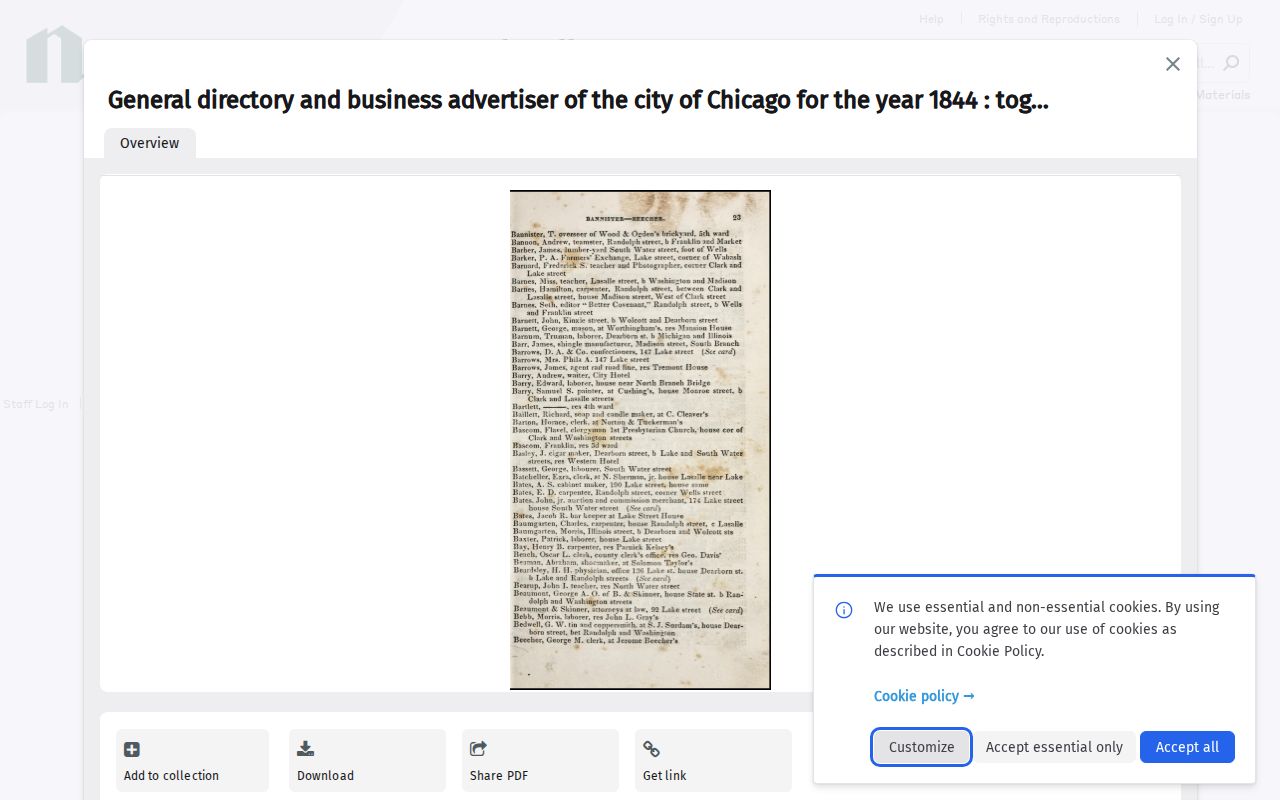
An entry may lack a number yet still locate someone between two cross streets. Occupation and nearby street names can be stronger search keys than a modern address.
Chicago Directory Publishers by Era
Publisher changes are part of the evidence. The Newberry list begins with Fergus in 1839, then includes Norris, Hatheway and Taylor, Danenhower, Udall and Hopkins, Hall and Smith, Gager, Cooke, Bailey, Edwards, Lakeside, and other titles. Consecutive years may not share the same arrangement or symbols.
| 1839 | Fergus, the earliest year listed in the Newberry inventory |
|---|---|
| 1844-1861 | Norris through Cooke titles, with several publisher transitions |
| 1861-1871 | Halpin and Bailey, Bailey, Edwards, and a separate 1871 census-branded title |
| 1891-1918 | Lakeside runs listed for selected years |
| 1912-1943 | Chicago Central Business and Office Building Directory runs, not a simple household roll |
Record the full title, publisher, edition year, page, and column. That citation makes it possible to revisit the exact Chicago volume when another edition uses a different abbreviation or scope.
Decode a Chicago Directory Entry
The inspected 1844 sample reads: Casey, John, milkman, residence on Market Street between Randolph and Washington Streets. It supplies a name, occupation, residence marker, street, and cross-street span, but no fixed house number. Later volumes may add a spouse or widow note, business address, and owner or renter mark.
| Name | Surname and given name; initials and spelling variants matter |
|---|---|
| Work or affiliation | Occupation, trade, firm, or business address |
| Household note | Spouse, widow, boarder, or other title-specific notation |
| Place | Residence address, street, or early cross-street range |
| Status mark | Owner or renter symbols only when the volume's own key defines them |
- Criss-cross directory
- A volume arranged from address to name, useful when the building is known first.
- Householder index
- An address-oriented list of named householders, not a complete census of all residents.
- Abbreviation key
- The edition's legend for short forms such as residence, boards, widow, and occupation terms.
Photograph or transcribe the key before decoding marks. A familiar letter can mean something different in another publisher's Chicago volume.
Find Chicago Directories at CPL
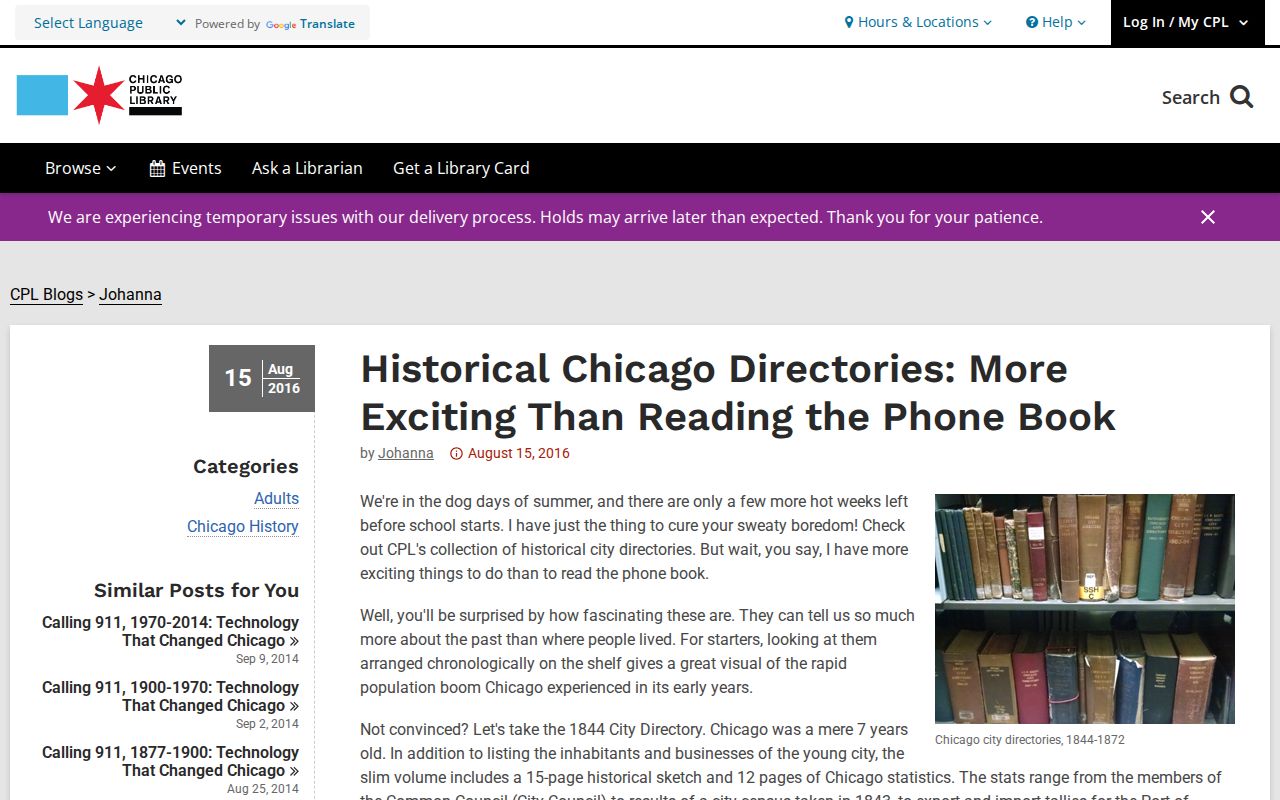
The Chicago Public Library genealogy collection brings directories into a broader research setting. Harold Washington Library holds directory and successor phone-book microfilm on the third floor. Older hard copies are kept in the fifth-floor Municipal Reference Collection and ninth-floor Special Collections.
CPL also offers Ancestry Library Edition inside library locations and HeritageQuest through a CPL-card login. Newspaper tools include the Tribune Historical Archive, Defender holdings, Newspapers.com Illinois titles, and historic telephone directories from the Library of Congress collection. Access differs by product, so an onsite visit, card login, or microfilm reader may be the required channel.
The CPL directory and Haines explanation is pictured below.
Repair Old Chicago Addresses
A printed Chicago address may be right for its year and still fail in a modern map. Most house numbers changed in 1909, with final changes effective April 1, 1911. Ann Street became Racine in 1928. Pulaski was once Crawford and earlier 40th Avenue. Search each historic form before deciding an entry has disappeared.
CPL's City Clerk Street Guide, old-and-new number guide, Municipal Reference Map Index, and MRC Street Name Index help translate the text. Sanborn maps then anchor the street to building outlines and cross streets. The 1910 census and a 1910 directory should also be read with the pending number change in mind.
Note: The State and Madison grid is a useful check, but the dated street guide controls a historical Chicago address.
Extend Chicago Directory Clues
Newspapers can explain a brief directory line. CPL lists the Tribune archive for 1849 through 2016 and the Defender for 1910 through 2010. Its microfilm inventory also includes the Broad Ax, Chicago Daily News, Chicago Eagle, Chicago Examiner, and other local or ethnic titles with specific runs. Search an address, trade, church, relative, or death date along with the name.
The CPL Sanborn index covers Chicago series from 1894-1897 and 1905-1951. Sheets can show a building footprint, number of stories, material, use, and nearby hydrants. They do not identify every occupant, but they test whether the structure and address fit the printed entry.
Migration and language history also matter. Chicago Catholic records, cemetery collections, the Defender, naturalization petitions, and community archives can test accented and unaccented names, maiden names, initials, anglicized spellings, and surname-first forms.
Chicago Archives Beyond Microfilm
The Chicago History Museum Research Center holds printed works, manuscripts, photographs, architecture files, and local history collections. ARCHIE is its public catalog. During the inspected 2026 summer schedule, the center was open Tuesday through Friday from noon to 4, with no paging after 3. Current access should be checked before travel because catalog moves were underway.
The center permits cameras, but it does not copy city directories, newspapers, scrapbooks, maps, color items, or pre-1900 photographs. That makes careful onsite notes vital. Newberry complements it with more than 1,400 maps spanning 1779 to 2003 and directory film behind the reference desk.
IRAD at Northeastern Illinois University reaches far beyond printed directories. Cook holdings include burnt-record court indexes, building-permit registers from 1893-1894, probate files, vital indexes, ward maps, and nearly 35,650 pre-fire Chicago documents identified across the system. The Great Fire damaged records, but it did not erase every earlier trail.
Trace Family Through Chicago Directories
Follow a household across years, not just one page. Directory evidence works best when it is paired with a census, vital index, obituary, probate file, deed, or permit. Federal census releases follow the 72-year rule. A directory is a dated statement of association, while a deed speaks to title and a census captures a household on its enumeration date.
- Choose a surname, year, occupation, church, business, or cross street. Search spelling and initial variants.
- Transcribe the whole entry, including spouse or widow marks, residence and business labels, and abbreviations.
- Move forward and backward through nearby directory years. Note address moves, changed work, removals, and gaps.
- For a known address, switch to Haines criss-cross and test both old and new Chicago street forms.
- Pair a public census year with the directory, then test the person in newspapers, vital indexes, probate, or deeds.
A missing name can mean death, a move, an unlisted household, a publication gap, a spelling change, or a changed address. It does not supply the answer by itself. Modern address-keyed research belongs in the Chicago street directory, while these volumes preserve the historical shelf.